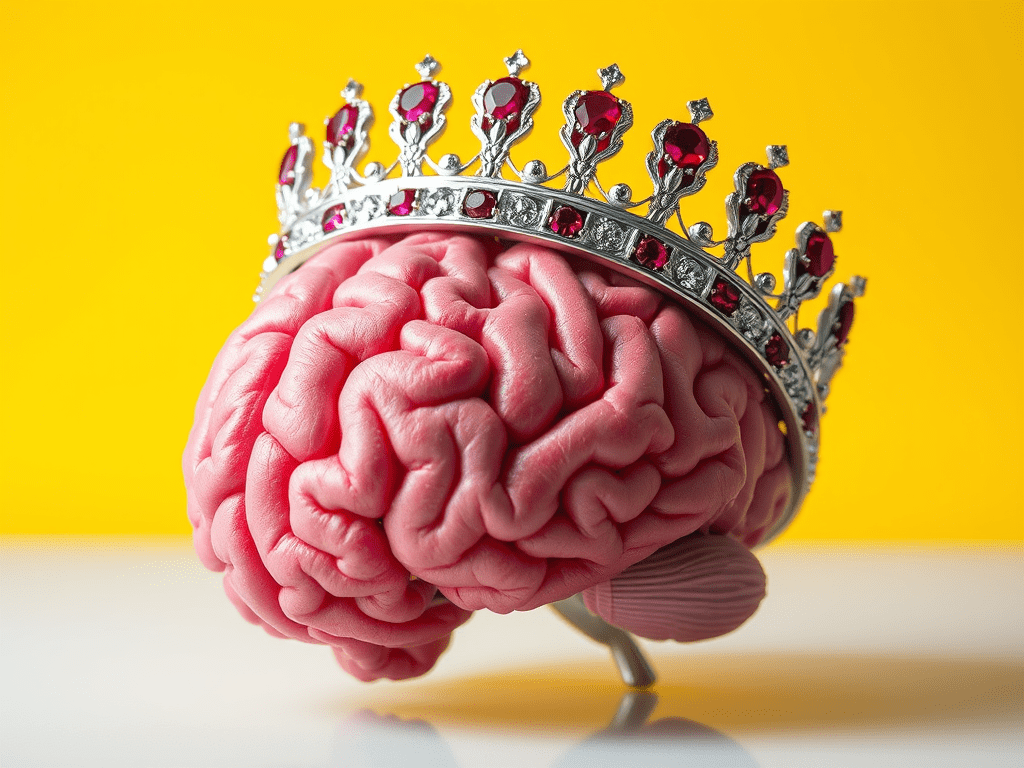
Most people assume an explanation of consciousness will be in the language of neuroscience and dazzle us with details about how the brain works. But this is a symptom of a widespread metaphysical confusion. The challenge of the hard problem of consciousness cuts much deeper. It asks whether neuroscience is even the right explanatory domain.
Those who say future neuroscience will provide a solution haven’t responded to the hard problem. They’ve ignored it. They’ve handed us an explanatory IOU promising to repay the debt in the wrong currency. It’s not the delay in giving an explanation that’s a problem, but the fact they’re trying to pay the debt using the wrong kind of explanatory stuff.
This response isn’t rare. We find this kind of IOU given out freely in popular media. The physicalist argues that although current science can’t explain consciousness, it eventually will. The physicalist will often support this by telling us that the history of the advancement of science is characterised by replacing supernatural explanations with natural ones. That history should make us sceptical of anyone who says science can’t explain something. Or so the story goes. Even if this story was accurate as historical fact, it’s irrelevant, because it doesn’t rise to the level of being an actual response to the hard problem of consciousness.
To see why it’s irrelevant we need to look more closely at what the hard problem asks. Generally it’s phrased as the problem of explaining how the brain gives rise to consciousness. But asking how something happens already presumes that it does happen and once we’ve assumed that, the only thing left to do is fill in the details of how it works. The hard problem isn’t asking for neuroscience details. It’s asking why subjective experience exists at all, and if its existence can be explained by only telling us about the physical processes in the brain.
If this is what the hard problem asks, then neuroscience itself has been challenged. Since any neuroscience explanation is called into question, that includes future neuroscience. Responding to the challenge needs an explanation of why neuroscience is the correct discipline. The hard problem needs to be answered before starting work on neuroscience theories.
Why more science won’t bridge the gap
The logic behind this becomes clearer when we consider the structure of ordinary scientific problems. They have certain features in common. In a scientific problem we already know what type of thing we’re dealing with but we don’t know the mechanisms involved, or we lack data about the theorised mechanisms. In those cases observation and theory can bridge the knowledge gap.
These kinds of problems are what Chalmers called the easy problems. For example, we might want to know how memories form in the brain. We know that memory is a biological process so the mystery can be solved by finding the brain mechanisms responsible for encoding those memories. We need empirical investigation, data collection and theory refinement. Science is the best way to answer questions like this.
Now contrast this with consciousness. The hard problem isn’t asking how a particular mechanism works. The hard problem is asking, why are any of these biological processes in the brain accompanied by an inner subjective point of view? This isn’t searching for knowledge of biological mechanisms.
It challenges the assumption that subjective experience belongs to the biological category at all.
We can imagine a perfect map of the brain that doesn’t include any experience. There’s no logical contradiction in a silent brain that functions perfectly. That means the physical description doesn’t logically require experience. And if the challenge is right, then no amount of data or empirical knowledge can bridge the explanatory gap.
Why Consciousness is a Philosophical Problem
If science isn’t the right explanatory tool, what is? The right tool depends on what you want it to do, the question you want to answer.
The hard problem isn’t a question about the properties of some unknown phenomenon. If someone doesn’t know what a ball is we only need to tell them about its properties. We can describe its spherical shape, its mass, the material its made of and the functions it performs. But everyone already knows what consciousness is and the phenomenon we’re pointing at, because we’re all conscious.
We’re also not dealing with a theoretical entity we read about in a science textbook. Something that’s proposed to explain other data in the world, like élan vital was proposed to explain the functions of life.
Consciousness is the datum to be explained. Arguably, consciousness is even more fundamental than this. It’s the pre-condition of there being any data whatsoever. We’re all intimately familiar with this phenomenon. We spend a lot of time talking about it and trying to enhance it. We want to experience what it’s like to be happy and satisfied, rather than what it’s like to be in pain and miserable.
So if all of that is obvious to everyone, what is it about consciousness that needs explaining? This is a topic in philosophy of mind and is often called the mind-body problem. It’s metaphysics of mind, and metaphysics is the study of reality in its most general features.
The question is, how does consciousness fit into the world? How is it related to the other stuff in the world, how is it related to our body and more specifically our brains? Do our brains produce consciousness like boiling water produces steam? Or are brains more like filters of consciousness rather than creators of it?
Once the question is clear, it’s apparent that many discussions about consciousness ignore the hard problem while giving the illusion the problem has been solved, or will be in the future. It’s only iff physicalism is true that neuroscience is the correct discipline to explain consciousness. We aren’t dealing with competing theories within the physicalist’s mechanistic view of nature, we’re judging competing metaphysical theories about what nature is.
There’s a whole world of stuff out there, chairs, planets, pains, hopes and dreams. And the question is a philosophical one. We want to know how all those things hang together in the grand scheme of things. Physicalism’s answer has become culturally dominant and we need to understand why.
The Cultural Dominance of Physicalism
Physicalism says consciousness, like everything else, is a physical thing. But there are many other possible answers like substance dualism, panpsychism or idealism. Panpsychism, for example, says that consciousness is present in all matter. All of these alternative views explain the relationship of experience to matter in an overarching view of reality.
Many of these alternative views say that consciousness is fundamental, it doesn’t emerge from the physical. And if the hard problem has undermined the idea that physical explanations are adequate, the alternatives can’t be ruled out on scientific grounds. None of these views are anti-science. None of them deny or contradict any scientific knowledge.
They’re all ways of interpreting the data into a comprehensive logical system that explains how reality hangs together. That includes theological alternatives like classical theist traditions.
Even though many frameworks exist, physicalism has become dominant because of the assumption that only scientific explanations are legitimate. But this is a metaphysical prejudice, not a scientific conclusion.
Scientific method has delivered extraordinary predictive and technological success. Along with that success came extraordinary cultural authority. We increasingly came to view and understand the world through a scientific lens. We went from using science to describe nature, to thinking science defined what nature was. A method slowly morphed into a metaphysics.
Education, media, and popular science writing reinforce the message that science is our only reliable source of knowledge. Physicalism became the background cultural view, not because it was argued for, but because it was continually associated with scientific prestige.
And so it’s not surprising that we would do the same thing for consciousness and expect a scientific explanation. But this expectation isn’t a harmless cultural habit, it invisibly shapes our outlook on many other questions.
Why This Question Matters: Existential Stakes
Why does any of this matter? Why worry about one hard problem neuroscience can’t answer when it can answer so many other important ones?
It matters because existential questions of great consequence flow from how we understand consciousness. Telling us what consciousness is also tells us what we are, and so naturally, it attracts interest outside of academic philosophy. This is why consciousness is a popular topic among non-philosophers. Not many people care about niche topics in philosophy. No one is getting into passionate debates on the internet about the problem of universals or the identity of the ship of Theseus.
The theories about consciousness tell us if consciousness is physical. And whether consciousness is physical tells us if there is a soul beyond the body. The answers to questions like who you are, why you’re in this world and what happens at death are all downstream of your metaphysics.
People take the unspoken metaphysical commitments of physicalism for granted. Many people think that science has shown there is nothing beyond the physical world, nothing supernatural. No God, no immortal soul and no afterlife. But these are all conclusions of physicalism, a metaphysical claim, not a scientific one. And it’s physicalism that’s challenged by the hard problem, not science.
Beyond Mechanism: Meaning and the Limits of Reductionism
The hard problem of consciousness shows us that neuroscience may never explain consciousness. If that’s true, it means the conceptual space of this conversation needs to be reopened. Rather than seeing this as a regression to pre-scientific ways of thinking, we should see this an exciting opportunity to expand our intellectual horizons. A chance to develop new ways of understanding nature that incorporate and synthesise all the accumulated knowledge of humanity.
The idea that if explanations don’t appeal to physical mechanisms they’re inferior has already conceded the intellectual ground to physicalism. It restricts our outlook and forces us to fit the data to the theory when the reverse is the way we develop knowledge. We tailor our theory to fit the data.
There’s a deep irony here. One of the reasons science and induction is so successful and admired as a method of gaining knowledge is its commitment to that principle. But physicalist theories in modern philosophy of mind often do the opposite. They reconfigure consciousness into concepts that fit within the physicalist paradigm. Qualia are eliminated, or reduced to an illusion, or the mere functions they perform.
Even reducing the question of consciousness’ place in the world to a conversation about qualia or intentionality has already flattened our intellectual outlook. Physicalists talk about “folk theories” of consciousness as if non-scientific explanations are primitive attempts to answer these perennial human questions.
When we talk of our hopes and dreams, beliefs and values, and the meanings of all these things, we’re not proposing a theory to explain the mechanisms of action. We’re not explaining why the legs move a certain way or particular neurons light up, as if human behaviour is exhaustively explained by describing the mechanisms that move the body. An explanation of the mechanisms of dopamine release doesn’t contribute knowledge of how to achieve lasting satisfaction or live a good life.
This suggests a theory of consciousness has to address more than mechanisms, it must deal with the human condition. The meaning of life, the values we have, how we should live. And these are the theories of the wisdom traditions. The arts, philosophy, religion and mythology. It’s on these wide intellectual horizons that physicalism must compete, not claim the conceptual space by default.
 Unity in Difference