Few doctrines have done more to diminish faith in a loving God than the idea some people will suffer eternally with no hope of redemption. For many people, this isn’t an abstract theological puzzle, this is the image of a loved one lost forever. The doctrine’s moral repugnance and its prominence in the Christian tradition combine to create doubt that Christianity is true. Its emotional and moral weight becomes a reason to reject not only Christianity but belief in God altogether.
But what’s missing from these discussions is exploration of alternative frameworks to the traditional Christian view. This article presents an alternative view found in Hindu metaphysics that addresses these theological objections. In this view hell isn’t a future destination for the evil, but an existence we already inhabit. It’s real, but not eternal, and so God’s benevolence is preserved. The framework avoids the paradoxes that arise in Christian theology while taking human suffering and divine goodness seriously.
The Hindu metaphysics
To understand this view, we need to understand a little about Hindu metaphysics. In Hindu philosophy, the fundamental nature of reality is known as sat-chit-ananda, which means eternal, conscious bliss. This is called Brahman. We can roughly translate Brahman as God, but with one important difference.
While the Western tradition sees God as a ruler or judge, whose final verdict decides a soul’s eternal fate, Hinduism views Brahman as the ocean in which we float, the ground of all reality. Everything that exists participates to some degree, in the reality of Brahman. Brahman describes absolute existence, absolute knowing and absolute bliss.
The Sanskrit word sat can be translated as eternal, but it can also mean existence, truth or reality. Hinduism recognises that anything that ceases to exist doesn’t truly exist, so sat means to exist without cessation.
This Hindu metaphysics gives us the same generic properties of God we find in the Western traditions. God as the ground of all being is omnipotence, the all powerful causal ground of reality. Chit, or consciousness, is omniscience, and ananda, or bliss, can be thought of as omni-benevolence.
God’s Will as the Fabric of Reality
God’s omnipotence means his will is the source of all movement in the world. Omnipotence isn’t the same as saying God chooses every discrete event, it’s a description of the structure of reality. It means at the most foundational level of reality, everything in existence is following God’s will.
Just as gravity governs our movement without directly causing every step we take, God’s will is the structure in which all movement occurs. This isn’t something we can change without changing the type of thing reality is.
But this creates a puzzle, if everything moves according to God’s will, how can we experience separation from God? How can our will deviate from that movement? This is where freedom is pivotal. To be free to act against the movement of reality itself means God’s will must be concealed or suspended.
If the full reality of God was available to us, we wouldn’t be able to deviate from that. We must be free to ignore, or move in dissonance with God’s will. To do what we want to do, even if that isn’t what God wants. And a reality where God is hidden, requires a certain structure.
What is this structure? It becomes intelligible when heaven is understood not as a place, but as a state of being.
The Positive Reality and its Absence
The Hindu view of God is also a description of heaven. But heaven in Hinduism isn’t a geographical location reserved for a life beyond this one. It’s a positive state of conscious existence, a full and blissful participation in the life of God. If we align ourselves with reality’s ultimate nature, we experience the fullness of that state of being. This is the positive reality, not created by law or decree, but a description of what the nature of ultimate reality must be like.
In Hinduism hell isn’t an opposing force to heaven, it’s a privation or diminished version of heaven. Just like darkness isn’t an opposing force to light. Darkness isn’t a reality unto itself, but merely the various shades and intensities that are created by the absence of light.
What would it be like to exist with reduced participation in eternal, conscious bliss? A world of partial participation wouldn’t be morally neutral, its nature would include decay, ignorance and pain.
That world would have a reduction of eternality or existence: This would produce things that have impermanent existence. They have a beginning, undergo change, before eventually ceasing to exist. This is the temporal nature of matter.
It would have reduced chit or consciousness: This would mean certain aspects of consciousness were veiled, which would produce the appearance of a mechanistic substance, governed by blind laws rather than conscious intention. And it would have a reduction of ananda or bliss: This would produce suffering, not as a punishment but the natural result of a privation of bliss.
This partial negation of Brahman describes the material world.
Matter is temporary. Everything degrades and eventually dies. Our bodies wear out, mountains erode, even the stars will burn out and die.
Matter has the appearance of unconscious insentient stuff. Its movement is predictable because it doesn’t deviate from blind mathematical laws, it doesn’t choose or have goals or values.
The material world involves unavoidable suffering. Disease, natural disasters, ageing, death. These are woven into the fabric of the physical world.
The Good News Revisited
It’s usually better to give the good news before the bad news, but I’m going to do it the other way around.
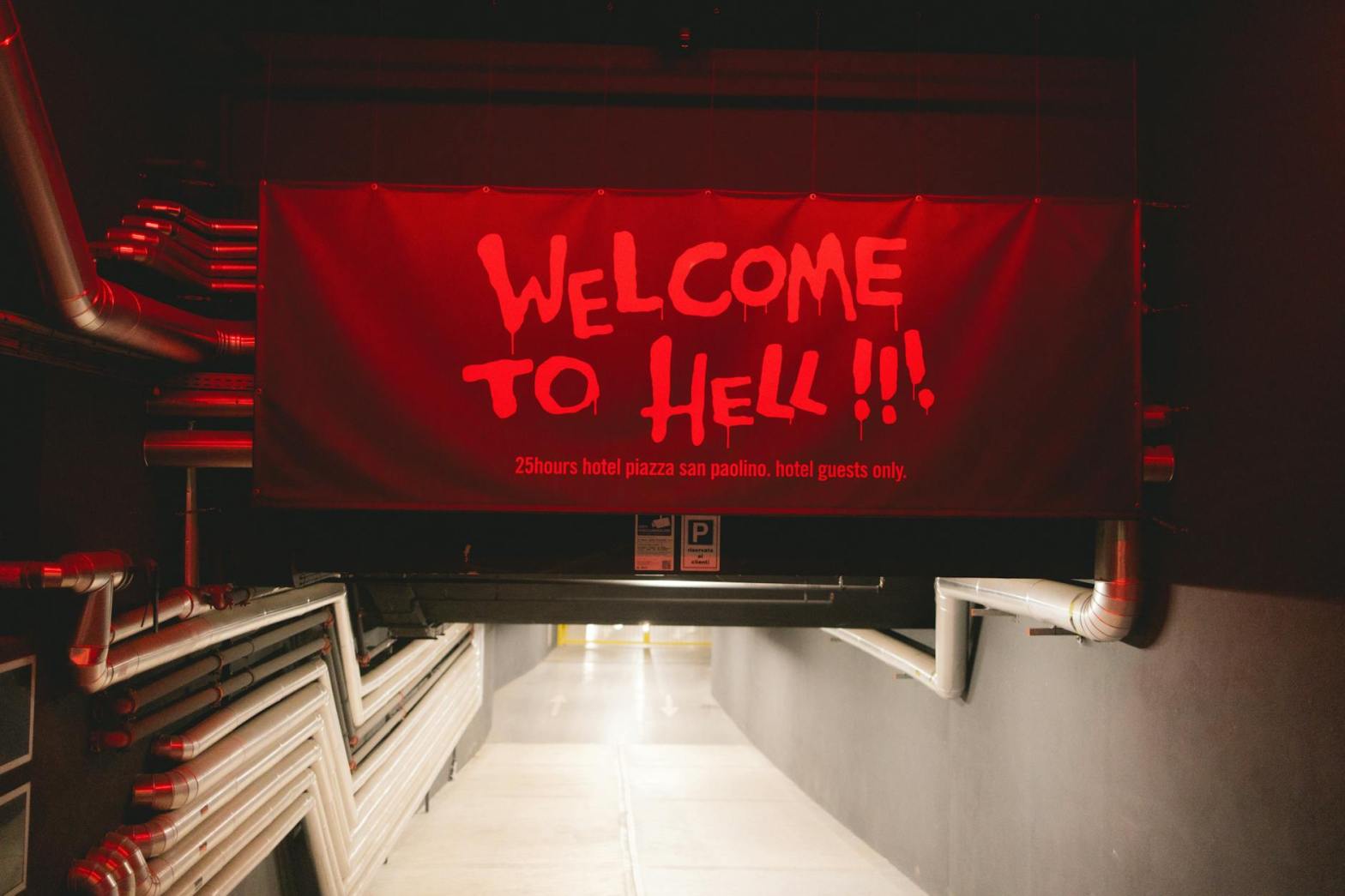
The bad news is that hell is real, and you’re living in it right now.
The good news is that hell is not, and logically can’t be, eternal.
Suffering isn’t a punishment inflicted on us by an angry God who wants his own way. It’s the experience of being out of harmonious alignment with the deepest current of reality. When we move against the flow of bliss, we experience suffering.
Hell isn’t a judgement imposed on us for making wrong choices, but a condition of dissonance with the movement toward the highest good. A musician playing in the wrong key will experience dissonance, not because the laws of music are punishing them, but because they are out of tune with the foundational scale.
No one is evil by nature or deserves punishment or condemnation from God. We place ourselves in a condition of dis-ease by our choices. When we learn to move in harmony with God’s will, to act for the universal interest and not our own selfish provincial interest, we’ll find ourselves immersed in an ocean of bliss.
The Hindu view dissolves the paradox of eternal punishment while retaining the moral seriousness of suffering and the urgency of seeking liberation. God is patiently waiting for everyone to remember who they are, and return home. Hell can’t be eternal, it’s a temporary misalignment. What is eternal is the reality hell obscures.
 Unity in Difference