James Clerk Maxwell’s work on electromagnetism was among the most important scientific achievements of the nineteenth century. Yet his contemporaries were slow to appreciate and understand his work. One of the reasons Maxwell’s theory was unappreciated was the difficulty of understanding it within the prevailing scientific paradigm. It required a conceptual shift. Maxwell replaced the Newtonian model of action at a distance with a universe permeated by fields. In this view, mechanical forces weren’t the primary actors, they were the visible behaviour of the fields.
The idea of a field was hard to visualise because it was intangible. The scientists of the time tried to visualise fields as mechanical structures extending throughout space. Maxwell’s theory becomes elegant and intelligible when you reverse your thinking. Instead of the mechanical universe being primary and fields secondary, fields are primary and mechanics are secondary.
The view of the world that emerges from Maxwell’s theory proposes two descriptive layers as a model of reality. The first layer, the layer of the fundamental constituents, consists of fields obeying general mathematical laws. The second layer, the layer we can touch and see and interact with, consists of mechanical forces and energies. In this model, the most basic processes of nature aren’t directly perceptible to our senses, they exist within a fundamental layer that lies beneath our conscious experience.
Just as Maxwell’s contemporaries had to reverse their assumptions about matter, we may need a similar reversal to solve the hard problem of consciousness.
Consciousness resists physical explanation. We can explain how the brain processes information, how neurons fire, but what we can’t explain is why that should feel like anything at all. Why isn’t it just going on in the dark with no one experiencing it? That gap, between the physical process and felt experience, is the hard problem of consciousness.
Most modern answers to the hard problem of consciousness assume that consciousness emerges from the activity of the brain. But that assumption is doing all the work. This strong sense of emergence is a placeholder for an explanation, it’s only telling us what needs to be true if physicalism is true.
That’s not a solution, that’s a restatement of the problem.
The intransigence of the hard problem has caused a growing number of philosophers to explore alternatives. When we ask how consciousness emerges from the brain, we’ve already assumed it does. But what if the reason the hard problem seems impossible is that our starting assumption is mistaken?
What if we reversed our starting assumption. What if consciousness doesn’t emerge from matter at all? What if we have the order of explanation backwards?
Instead of assuming that matter is fundamental and consciousness emerges from it, we assume the opposite is true. This reverse view says that consciousness is fundamental and matter is secondary. Reality, at its base, is a single field of consciousness.
Of course this raises its own questions, if there is one universal consciousness, how can we explain all the individual subjects like you and me? We are distinct centres of awareness that don’t have access to each other’s inner states. Which means the unified field must somehow separate into distinct subjects, a challenge known in philosophy as the decombination problem.
The other question is, if reality is a unified field of consciousness, how do we explain that matter appears to lack subjectivity and its movement follows impersonal laws? If reality is conscious, how can we respect the findings of modern science as giving us accurate knowledge about reality?
The view I’ll present in this article offers a solution to the hard problem, the decombination problem, and still preserves the reality of the external world and the validity of science. It’s from a school of Indian philosophy known as Gaudiya Vedanta and proposes reality is one conscious energy that transforms into individual subjects and objective forms. This is a real transformation, but it doesn’t entail distinct substances. We can think of this transformation as unity in difference.
To understand how this single field can transform without changing its essential nature, we need to understand the characteristics of the field itself.
Consciousness as a Luminous Field
The best way to visualise the conscious substrate is by using a metaphor of light. This gives us a useful analogy to explain this metaphysical view.
Consciousness is self-luminous. In the same way that we don’t need a torch to illuminate the sun, we don’t need something else to show us our own consciousness. Consciousness is like the light source, not an object revealed by another light source. This is why light is a good metaphor for consciousness, because like light, consciousness isn’t an object in the world, it’s the radiance that reveals the world to us.
While we call this a field, we shouldn’t think of it in terms of substance, but instead as energy or dynamic activity. Light is a strange phenomenon, it’s not stuff we can grasp, its inherent nature is dynamic. Physics says light has zero rest mass, which means if it’s not moving it ceases to exist. Consciousness works the same way, its nature is dynamic. We’re always aware of something. Even in deep meditation, when our awareness of the outside world has disappeared, consciousness illuminates itself.
Using this metaphor as our model, we start with reality at its foundation as a luminous field, consciousness in constant motion. The field is unified, unbounded and self-aware.
So how do we get from a unified and infinite field to our own individual consciousness and the world of matter we’re familiar with?
The Movement of the Field – Three Phases of One Energy
We start with an unbounded luminous field, but the field has two other modes of existence. The first is the individual subjects like you and me, and the second is the material world.
These aren’t distinct substances, they’re distinct phases of energy in the same way water and ice are both phases of H2O. Steam, water and ice are all different states of the same thing, but they all have different properties and behave in different ways. Steam dissipates, water flows, ice is solid, but they’re all equally real. This illustrates the idea of identity with difference.
So how does one luminous field become three modes? To understand this, think about what happens when light slows down.
When light slows, it’s not because it loses energy, it’s because its rhythm changes. As the light’s oscillating electric field passes through a region, it sets electrons in motion. The moving electrons generate their own secondary waves. When the original wave and these secondary waves overlap, they combine into a single new pattern. Because these waves are slightly out of sync, their combined movement is a new wave that moves more slowly. This is refraction: a change in the wave’s speed caused by the patterns of its own internal interference.
Refraction is the bending and slowing of light, but it’s the same light, the same energy. Its behaviour changes, its outward manifestation is different.
This view sees individual subjects and material objects like refracted light. The luminous field refracts into different degrees of constraint, variations in the intensity and speed of the waves within it. We could call these density variations within the field, but it’s a density of movement, not of stuff.
This slowing of the waves leads us to the formation of stable and localised structures within the field.
Localised Waves – The Individual Self
Picture an unconstrained luminous field and imagine stable patterns forming within that field. Think about what a standing wave looks like, a pattern where nodes on the wave appear stationary while the wave around them continues to move. These nodes keep their structure over time despite the constant motion of the field around them.
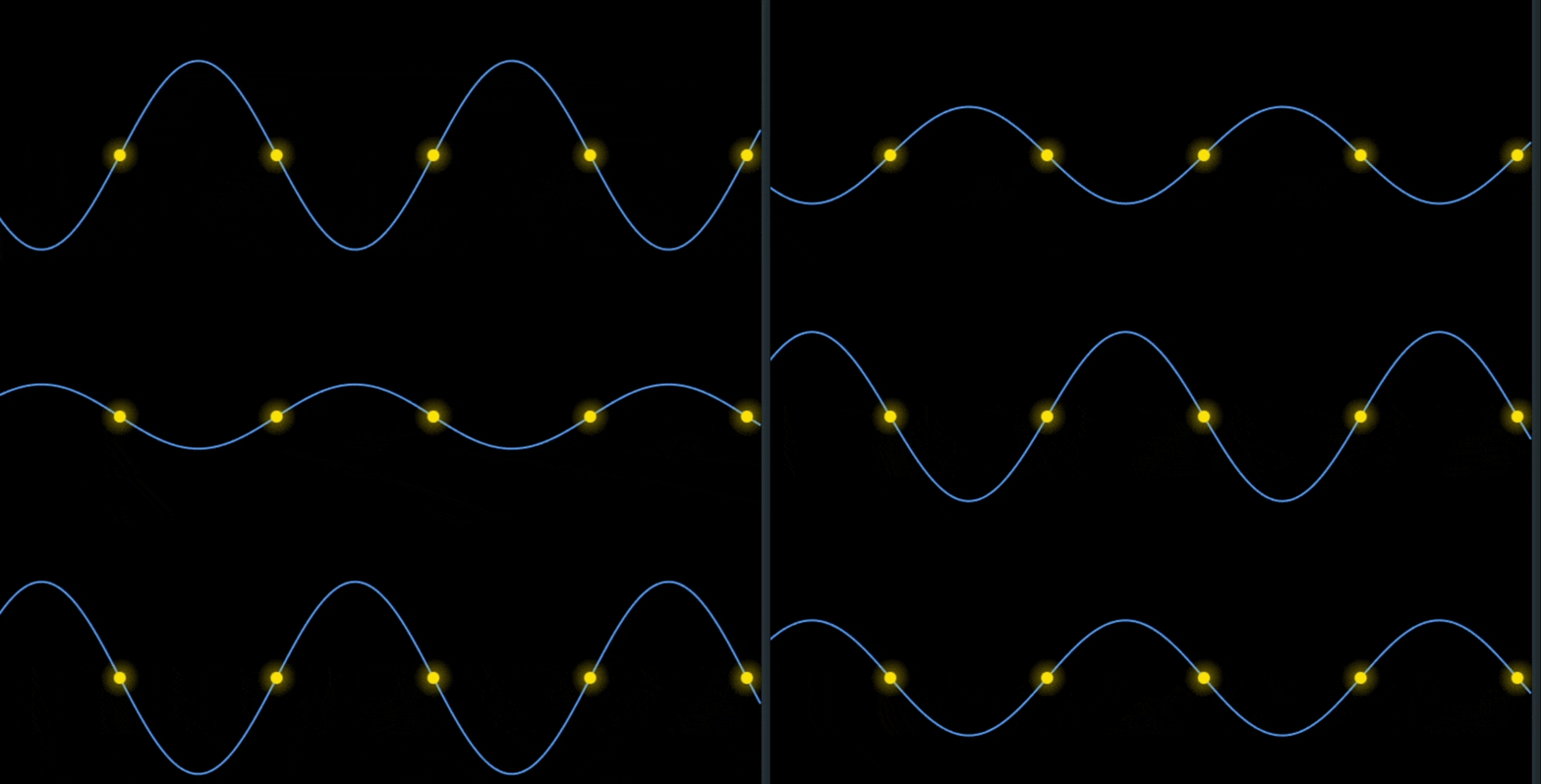
The individual subjects, like you and me, are like standing waves within the conscious field. Each subject is a stable and persistent centre of awareness, a unique perspective that doesn’t vary although the field around it does. Each node is a unique mode of consciousness. It’s a real and persisting transformation of the field, but also not something completely different from the field in which it exists.
This gives us a coherent solution to the decombination problem. There is no fracturing or disassembly of a cosmic mind into disconnected parts. Individuality consists of the differentiated patterns within the unified field. Each subject isn’t an illusion within the cosmic mind, nor is it independent of that mind.
The key difference is localisation. You’re aware and conscious, but that awareness is centered at a particular node of perspective, which is just to say you’re a particular individual subject. You don’t share the same experience as me or anyone else, because we’re both localised standing wave patterns anchored at different positions within the field.
This explains why there are many subjective points of view within the field, but the field has another mode, one that has no interiority at all.
Matter as the Frozen Geometry of Light
Now we come to the most counter-intuitive part of the theory, the nature of matter. If everything is conscious, matter as we know it seems like a problem. Rocks don’t think and tables don’t feel. Your stove has no inner world.
How does a consciousness first view explain things that appear to have no consciousness at all? The answer requires us to see matter not as the absence of consciousness, but what consciousness look like when it has become self-occluded. The light is still there. You just can’t see it from the outside.
It’s also intuitive to think that if everything is conscious, matter must somehow not be fully real. It must exist in our mind, or God’s mind or its existence must depend on a mind to observe it. How do we get the solid, persistent objects of our shared external world from a luminous field?
In this view, matter is where the conscious field becomes maximally constrained. Think about what happens when light forms an optical vortex. A beam of light twists as it moves forward, forming a spiral. The twisting creates a region of self-interference in the centre, the constraint produces a point of occluded light, much like the hollow core of a whirlpool.
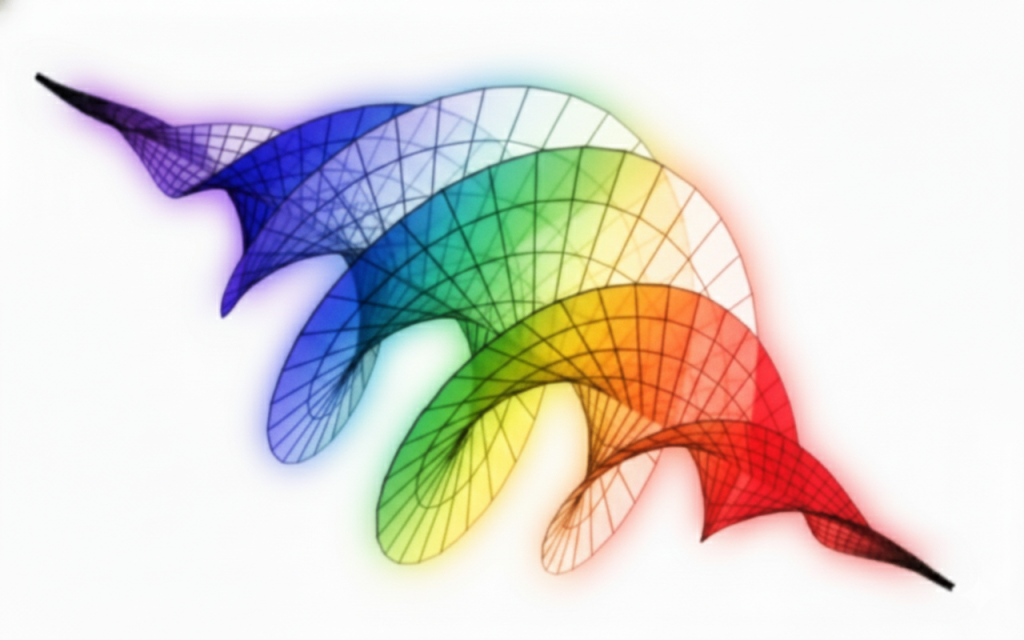
Our vortex analogy is helpful because it captures something important about how constraint can produce structure. Imagine these vortices becoming so tightly wound they loop in on themselves, forming a knot. To an observer the knots behave like solid pillars, even though they’re entirely made of the activity of the field. The field refracts into regions of increasing density and constraint. Where that constraint is maximal, stable and persistent structures emerge. They’re real features of how the field is structured at that location.
The vortex analogy can also help illustrate why matter has no interiority. The core of the optical vortex is dark, occluded. The spiral is so constrained the inner luminosity of the field has been cancelled out. What remains is pure structure, pure pattern. This means there is nothing it is like to be a rock, an electron or any material object. There is no local perspective guiding its movement. It moves only in response to external forces and from the outside it appears causally closed.
These patterns aren’t illusions in anyone’s mind, they’re the external surface of the field. They obey lawful regularities, they stay in existence when no one is looking at them, and we can interact with them. But they’re not made of a different substance. Their real nature is a pattern of the luminous field, a mode of consciousness so constrained that its inner luminosity is eclipsed and only the external structure remains.
Vortices of the field explain the stability of matter, but we also need to ask why some material structures are accompanied by experience.
Where Do Brains and Biology Fit into This Picture?
It’s not called the mind-body problem for nothing. One of the puzzles is why brains and consciousness are so tightly correlated. Brain damage alters consciousness, and through plasticity consciousness alters brains. These mind-brain correlations are suggestive that the explanation could be one of production, consciousness somehow emerges from the activity of the brain.
With this consciousness first view, the empirical data of brain correlations is unaffected, but the interpretation of that data is changed. Brains are not generators of consciousness, but refractive structures that impose constraints. These constraints allow a stable conscious perspective to persist over time. Because experience can only appear through constraints, the structure that governs those constraints will be tightly correlated with the character and continuity of our experience.
For example, a guitar string doesn’t create the energy of the vibration, it constrains that energy into a specific note. A damaged guitar string produces a distorted sound, not because it’s creating less vibration, but because it can no longer sustain the necessary resonance pattern. Brain damage or stimulation alters consciousness for the same reason, altering a resonant structure alters a standing wave.
This doesn’t happen because consciousness is produced there, but rather because the standing wave can’t appear without those constraints. The brain doesn’t make you conscious any more than the guitar string makes the vibration. Remove the string and the vibration has nowhere to go.
The brain is like the interface between matter and subjectivity. It’s the refractive structure necessary to sustain a stable individual consciousness. Your particular brain is the structure that sustains your resonance pattern within the field. What we experience of the external world depends on the nature of both the objective patterns and our standing wave structure.
What it is like to be a human is different to what it’s like to experience the world as a bat, because we’re different localised patterns with different sensory and cognitive structures. The external world is made of consistent objective patterns, but how those patterns are experienced depends on the node experiencing them.
Biological structures more broadly are how the conscious subject encounters the world as an individual with needs, threats and possibilities. Experience has a structure. The qualities of pain, hunger, pleasure aren’t arbitrary. They’re the ways in which the organism maintains stable resonance, or in other words, sustains its existence. The particular biological structures we observe evolved through natural selection, which favours constraint patterns that solve these survival problems.
Evolution doesn’t create consciousness, it refines the structures consciousness can use to stabilise itself in its environment. Survival needs and dangers are all regulated through the particular qualities of the experience. Pleasure and pain guide the organism toward stability; they regulate behaviour, and behaviour is the organism’s effort to maintain homeostatic resonance, to tune its pattern to environmental conditions. In this view, qualia are not epiphenomenal but causally necessary. They’re the regulatory tensions needed to keep the resonance pattern stable.
From these biological considerations, we can step back and summarise what this framework accomplishes.
Where does this leave us?
This framework dissolves the hard problem. There’s no gap to bridge if consciousness is fundamental. It solves the decombination problem, we get individual subjects without needing to fragment the cosmic mind or reduce individuals to illusions.
It preserves the reality of the external world. The world isn’t an illusion but consists of objective, stable and real patterns within a unified field. It respects scientific knowledge. Nothing contradicts science or physics, but only situates it within a broader metaphysical context.
This framework invites us to reconsider the long-held assumption that matter is primary and consciousness is derivative. Maybe the more natural order is the reverse.
The hard problem appears unsolvable if you begin in the wrong place. If we start by assuming it emerges from matter it remains a mystery. Something that shouldn’t exist but inexplicably does. But if we start with consciousness, the existence of matter isn’t a mystery. It’s what the field looks like from the outside when its inner luminosity is eclipsed.
The hard problem dissolves because we’ve asked the right question.
This was the first article in a three part series, the second article is available here…

Featured image photo by NASA Hubble Space Telescope on Unsplash
 Unity in Difference