Many of us experience a quiet sense of dissonance between ourselves and the modern worldview. We know ourselves as conscious, intentional beings who seek meaning and value. But the modern worldview tells us the universe itself is indifferent and insentient. This creates a discord between our experience and our metaphysics.
This article takes that felt dissonance seriously. It argues that this isn’t a subjective or cultural problem, it’s a perception that the modern worldview is incomplete.
The previous article outlined a consciousness-first ontology as a response to the hard problem of consciousness. Reality was compared to a unified and luminous conscious field which had two other modes of existence. The first is the individual subjects like you and me, and the second is matter. The differentiation of the field is a type of refraction, density variations within one dynamic field.
This view gave us a way to explain how the universal field of consciousness decombines into individual subjects, while preserving the reality of the external world and respecting the discoveries of modern science.
This brings us to the point where we have a description of structure, but we haven’t yet explained the field’s dynamics. We need to ask how the field moves, why it moves and the force that causes it to move.
The natural movement of consciousness
The luminous and conscious field is inherently dynamic, it’s not a static substance. In a physical universe movement is mechanical, particles are pushed by external forces. In a conscious field, motion can’t be blind process because the field itself is aware.
The inherent and natural movement of consciousness is will. We direct our awareness toward what we want. Will isn’t a mechanical oscillation in a field that blindly follows external forces, it’s an internal force that chooses which way it wants to move.
We know from our own consciousness that this movement is always intentional, consciousness is always about something. Awareness must be awareness of something, which means will is always oriented in a particular direction. This orientation is so natural we rarely notice it.
We can compare will to a vector, it moves but it also has an inherent direction to that movement. There’s no such thing as will undirected toward an object of its desire.
So our will is the movement of our consciousness toward what we desire. While we might have many different desires, they all have one common characteristic.
The inherent direction of will
Our will is always directed toward a goal, and our goal is whatever we think is valuable and good. Like a compass always points north, our will always points toward the good. Whatever we think is valuable and desirable, our will moves in that direction.
The movement of will can’t be value-neutral. We can’t desire what we think has no value. Sometimes we make a mistake and think something is good but it turns out not to have the value we expected. But in these cases we didn’t aim toward something we thought was bad, we mistakenly thought something was good and discovered we were wrong.
So, our will always aims at what appears to be valuable to us at that time, even when we’re mistaken about its value.
If our will is inherently directed toward the good, then value can’t be an accidental feature of reality. The structure of reality must mean it’s possible for us to recognise value. The existence of hunger implies food is real. Hunger isn’t an illusion, it’s a signal that points toward something that can satisfy it. In the same way, the universal orientation of will toward value is a signal toward something real rather than a collective illusion.
Value isn’t a feature we impose on the world, it’s something we discover by participating in its structure.
Waves of will
The structure of the conscious field therefore has a vector-like character. Every subject generates movement in the field in the form of waves extending outward from itself. These waves are our will, desires, intentions and choices. They begin as inner movements in consciousness and are directed toward our goals.
These movements aren’t powerless wishes. They create real effects in the world. When we say all our actions create some movement in the field, this is just to say we’re localised causal agents. We can affect reality by the exertion of our will. This is the causal power of consciousness.
This consciousness-first view dissolves the mind-body problem because we don’t have a one-way causal structure. With naturalist worldviews we encounter an abiding mystery of explaining how sentience could not only emerge from insentient matter, but could then also have causal power over the substrate it emerged from.
But the two-way causal interaction between mind and body isn’t surprising under this view, because the causation consists of interactions between different modes of the one field. The subject isn’t something that emerges from a different substrate but a refraction, or different speed of movement within the same dynamic structure. The individual subjects and matter are embedded and integrated in the field. Mind affects body, and the physical affects mind.
As these waves of causal power propagate, they produce oscillations in the field like ripples spreading across water. But the field also contains innumerable other agents generating their own waves. As these waves interact, they form complex interference patterns.

This is common sense, it just means our actions affect the world and other people. In trying to fulfil our desires, we inevitably interfere with someone else’s desires. If our neighbour wants to blast their favourite heavy metal band while you’re trying to sleep, the divergent wills collide and interfere with each other. Whenever agents have different goals that create incompatible effects in the world, there is conflict.
So if we have many agents who have conflicting goals, and they all share the same field of action, some kind of coordination is needed. If there was no co-ordination, the interference patterns would create chaotic structure rather than stability.
Most of our goals require sustained and coordinated action and that requires a stable background with predictable results. There’s nothing mysterious about this. Without that structure, goals couldn’t be pursued.
On the most basic level our first desire is to survive, to continue our existence. This orientation characterises not only individuals but the movement of the field itself. Survival isn’t the highest good, it’s the precondition that must be in place before any other good can be pursued. Which means survival must be favoured by the structure of the field. Evolution by natural selection is one expression of this, it selects traits that sustain existence.
But survival alone can’t be the highest good. No one wants to survive at any cost. We judge some modes of existence as worse than non-existence, which shows that merely sustaining our existence isn’t the ultimate goal.
Beyond survival we want fulfilment. We seek goods such as knowledge, enjoyment, and relationship. Survival is an instrumental good, it’s a necessary condition that makes the pursuit of intrinsic goods possible.
The field as coordinator
A reality structured this way functions to coordinate all the localised wills. We should be careful not to think of function as something separate from the structure of the field. This isn’t something added to it, any more than the function of our will is to produce its visible effects. There isn’t some other thing outside the field throwing pebbles and creating ripples. The waves in the field are movements of will within consciousness.
This means the field itself encompasses all the localised agents, but it also acts as an independent agent. Individual subjects are expressions of the field at particular points, not separate from it, yet locally distinct. This is unity in difference: the agents are the same as the field in one sense, and different in another.
As a distinct agent, the field therefore has its own will and intention. It’s also conscious, which means its movements aren’t merely random. The field permits the actions of individual agents without forcing them, sustaining their freedom while governing the consequences. This isn’t the indifference of a mechanical system. It’s more like the patience of an impartial witness.
We can think of this coordinating role by analogy with an orchestra. An orchestra is made up of a collection of individuals, all with different instruments that produce different notes. A conductor is needed to harmonise all these divergent sounds. In one sense the conductor is part of the orchestra, yet at the same time also different from it. This is the same pattern of unity within difference.
The background field is like the conductor of an orchestra. It doesn’t create its own music, its movement coordinates the instruments into harmony. But a conductor does more than produce harmony, they evaluate and discriminate. They distinguish between better and worse, and their co-ordination enhances the music rather than allowing it to descend into chaotic noise. That points us toward a different understanding of what the laws of nature describe.
The laws of nature
To understand what the laws of nature describe in this view, we need to distinguish patterns from standards. The structure of the field itself coordinates the divergent wills. The responsive movement of the field maintains its coherent structure. The field harmonises all the divergent desires and goals of the individual agents.
We could think of the external and measurable aspect of this coordination as the laws of nature. Just as our behaviour is the outward movement of our will, the laws of nature discovered by science describe the outward movement of the field’s will.
This ordering principle isn’t like an engineer who sets the parameters of allowed movement and then stands outside the system. It’s the internal dynamics of the system itself. The system is constantly moving in response to the movements of all the agents. For every action, the field responds.
The first priority is the conditions required for each standing node to sustain a stable resonance pattern, or in other words survival.
The next priority is to coordinate the disparate wills of individuals so everyone can pursue their chosen goals. The mechanism is constraint. Everyone must obey the laws of nature, but within those laws, our free movement is allowed. This creates a stable and predictable environment that’s needed for individuals to pursue their chosen goals.

A goal means we have some purpose we want to fulfil. Intentional movement isn’t just motion, it has an inherent direction. So coordinating the movement of competing wills requires discriminating between possible outcomes. This means the coordination of goals must be more than blind process. Blind processes can generate patterns, but it can’t select for standards. It can produce stability, but it can’t explain why a particular outcome is the right one.
Standards imply intelligibility. Unintentional systems can produce structure, complexity and outcomes. But rationality can make judgements of better or worse, correctness or error, and improvement toward a goal.
Patterns vs standards
To see why coordination must be rational rather than mechanical, consider the difference between a pattern and a norm. A hurricane has a stable centre, the water in a river flows along the path of least resistance; these are both patterns produced by blind process. But none of those patterns can be right or wrong. There’s no standard to determine which path a river should take that judges some paths of the river to be in error.
We may think a river taking a path that floods a town can be judged wrong, but that judgement can only be made against our standard that flooded towns are bad. We provide that standard, the river doesn’t know anything about towns. The river itself isn’t making an error.
In the same way, natural selection can produce stable patterns, but it can’t explain why reproductive success counts as success in the first place. It can tell us which traits persist, but it must presuppose the standard by which persistence is judged as the successful outcome.
Coordination among the wills of agents is of a different type from mechanical patterns described by science. It requires discriminating between actions that achieve goals and those that undermine them.
A mechanical system can produce homeostasis, the maintenance of stable conditions, but it can’t produce normativity, the orientation toward what conditions ought to happen. It can maintain conditions relative to a function, but it doesn’t understand or evaluate that function. Homeostasis has no standard beyond continued functioning. It can’t distinguish between a life that merely persists and one that counts as flourishing, because flourishing requires a standard that mechanical process can’t supply.
Which means alignment in the field isn’t merely pattern. It’s an evaluative relation. The field selects, responds and can reorient. Error presupposes a normative standard, a rule to be judged against. And that objective judgement makes some outcomes right and some outcomes wrong. Normative standards require intelligibility, and intelligibility requires a mind-like structure.
Whatever coordinates competing wills must be able to distinguish better from worse outcomes. That capacity isn’t mechanical. It’s a characteristic of minds.
Because the coordinating principle is rational rather than mechanical, alignment with the field is orientation toward an independent standard of value. It isn’t submission to anyone’s preferences. Value isn’t created by participants, but discovered through alignment with the structure of the field.
If I hold my hand on the hot stove, I experience pain. Pain is experienced as friction, it’s a felt misalignment. I learn to avoid those interactions with the field.
Our movement is intentional, but resonance is responsive. Resonance can only be achieved by participating with the movement of the field. The field doesn’t oscillate randomly. It responds to our individual movement personally.
Because the field responds in structured ways, our orientation toward it has consequences. A responsive system can’t remain neutral to the direction of interaction.
Alignment and inner freedom
In this view, the good is alignment with the underlying field. The field is a harmonising force, and when we’re aligned with it, our will is directed toward the universal good. This means our will is in harmony with what is actually good, rather than a mistaken idea of what is good.
The movement of will that follows the universal good doesn’t harm others for personal gain. These kinds of movements align with the independent movement of the field. When our will moves in harmony with the field’s movement, there is no friction and we experience inner peace.
Peace requires harmonic resonance with the field. A tuned instrument produces clear music, an out-of-tune instrument produces only noise. By itself the instrument can’t know its own dissonance. It makes the music it makes. It can only know when it’s out of tune by registering with the conditions in its environment. It must judge its own music in relation to the musical scale, the other instruments and the conductor’s rhythm. Then it can discover its dissonance.
Alignment reduces inner contradiction. The harmony of inner resonance is with the underlying structure, like the musical scale rather than the melody being played. Alignment with the field is alignment with reality’s structure, not with surface events occurring within the natural environment. At the surface there is always friction because wills collide, but when our instrument is tuned to the conductor’s musical scale and rhythm, our experiential core remains in harmony even when chaos surrounds us.
This explains why aligning ourselves with the structure of reality creates the conditions for flourishing. But we still haven’t explained why flourishing should count as good.
Why misalignment feels like suffering
Everyone knows what it’s like to say something in anger that we regret. The regret we feel is the experience of having done something that conflicts with our real intentions. This kind of negative experience that accompanies different kinds of suffering isn’t arbitrary; it’s the lived experience of misalignment with the field. Misalignment isn’t punishment by the field, but the felt signature of structural contradiction. This felt experience can be instantaneous, or delayed.
Physically, this is obvious. Stepping on broken glass is experienced immediately as misalignment. Longer term, cumulative actions that affect our physical health will manifest their consequences. For example, the effects of a sedentary lifestyle accumulate with age.
Because reality is conscious, the same principle that applies to the physical also applies mentally. Inner flourishing requires intentional action. We might call this harmony with nature, but only if we understand that nature here isn’t an insentient universe; it’s a coordinated system that acts to harmonise the aggregate of wills. It’s primarily our own self-centred willing that prevents this harmony.
In this model, where the good is harmony with the field, we know it through participation. We may carefully choose something we believe will make us happy, only to discover we had misjudged its value. We realise we were mistaken in taking it to be good, not because its value changed, but because our perception did. Value isn’t first known by reasoning, it’s known by participation.
Harmony with the field goes beyond momentary pleasure or pain. Pleasure fluctuates, but harmony is structural. We’re describing a sustained resonance beyond mere survival. This is an existential well-being. Most of us can imagine a state of being that’s satisfied, peaceful, and unagitated, even if we don’t know how to reach it. This is what’s meant by harmony with the field. It isn’t found in immediate reactions, but in our existential centre, in what we might call our background resonance.
Everyone knows what it’s like to be pulled away from our centre of control by strong emotions. In anger we may do or say things we later regret. The desire for certain pleasures can have the same effect, causing us to compromise ourselves by pursuing overpowering impulses. Equanimity is prior to any particular emotional state. From this central equanimity we can stand as witness to our passing emotions.
This is like the difference between weather and climate. Climate is the background condition that produces transient weather patterns. Our core is like the climate and our emotions are like the weather. The emotions arise from sense perception: someone cutting us off in traffic spikes anger, missing a bus creates anxiety. These emotions are reactions to something that interferes with us fulfilling our desires.
If our actions are in alignment with the rhythm of the field, our core remains peaceful even when there are surface disturbances. Our core is the persisting background to our passing emotions. This background equanimity isn’t produced instantly, it’s a sustained condition. Like health, it’s not a trophy we earn and then place on a shelf. It requires constant and repeated actions to achieve.
Alignment is something we learn to recognise, it’s not something we invent.
Pluralism without relativism
Equanimity arises when we stand in the right relation to the field. The will of the field is universal: that everyone can flourish cooperatively, not that one agent flourishes at the expense of another. This is the universal standard. It’s only when each individual is in harmony with that standard that they can achieve inner peace.
This is like a plant that can only flourish when it’s in harmony with its environment. Each individual has unique characteristics that must be aligned with its environment. Those conditions are independent of the individual’s preferences, they’re an objective standard. Only when the individual is aligned with the external conditions can a harmonious resonance be achieved.
Because of our individual uniqueness, we can’t outsource this alignment, We have to discover it through our own participation, no society or tradition can do that for us. Sometimes that means we have to go against prevailing opinion, because harmony is determined by alignment with the structure of reality itself, not by alignment with group consensus.
Two different plants growing side by side may not flourish under identical conditions. That isn’t relativism; flourishing occurs when the nature of each individual organism is considered in relation to an objective structure, its environment. Harmony is achieved when each individual tunes itself to those conditions.
Value isn’t created by participants but discovered through alignment with a prior structure. It isn’t relative or a matter of opinion. It’s the alignment of the individual with the field’s harmonising motion.
Why metaphysics matters
If we accept a consciousness-first ontology, what follows? At this point, we may think all of this is an entertaining story but an explanatory extravagance. Science is extraordinarily successful at what it does. Even if the hard problem is real, maybe we should accept that we can’t know everything and focus on what we can know.
This is the modern attitude. We have an innate scepticism toward metaphysics because it seems to deliver speculative knowledge that’s difficult to confirm. When we contrast this with science, a method that is designed to test claims against reality, metaphysical claims seem risky in comparison.
But before we close the door, we should ask whether this view offers explanatory successes we can’t achieve if we treat naturalism as merely a practical metaphysics.
Science explains measurable interactions, but it presupposes rather than explains consciousness, value, and rational norms. These aren’t optional features we can exclude from explanation. They’re the necessary preconditions of enquiry itself. Naturalism depends on truth, inference, and the value of evidence. These are norms required in any explanatory project. That they must be presupposed doesn’t mean they don’t need explaining.
A worldview doesn’t fail simply because it can’t explain everything. It fails if it can’t account for what makes explanation possible in the first place. That’s not a small explanatory hole we can disregard.
It’s a structural failure in the foundation.
Science depends on knowledge, inference, and evidence. If a framework can’t account for the very possibility of knowledge, that isn’t intellectual humility. It’s a structural limitation. Any worldview that can’t account for what makes knowledge possible can’t claim to be sufficient.
Physical processes generate events, not norms. A working hypothesis may suffice for laboratory models, but not for ontology. The question isn’t whether naturalism works. It does. The question is whether it explains enough. Naturalism isn’t false, it’s structurally incomplete. Naturalism isn’t wrong about what it describes. It’s one of the great achievements of human enquiry. But it inherits its standards without being able to explain them.
That isn’t a criticism of science. It’s a question about the foundation science stands on. The question doesn’t go away no matter how successful the method is.
We’re not faced with a choice between science and metaphysics. We must choose which metaphysics can make scientific enquiry intelligible.
Where does this leave us?
We can now step back and ask what this consciousness-first framework accomplishes. We’re presented with a picture of a dynamic and luminous reality. We don’t exist on the surface of a static world, but are fully immersed in a dynamic and responsive reality. Our experience of the world depends on our participation. And that world is structured to quietly lead us toward flourishing.
The hard problem dissolves because consciousness is where explanation starts, we don’t try to retrofit it into a laboratory method. Individual subjects are real. They’re distinct but connected persons. They’re not illusory nor a pathology of reality. Matter is real, our perceptions of it accurately inform us of its true nature and the discoveries of science are valid and respected. Physics knowledge is intact within its proper domain.
Our metaphysical views aren’t neutral intellectual theories, they form the interpretative lens through which we view the world. And that in turn affects how we interact with, and experience the world.
In other words, metaphysics isn’t an abstract pursuit confined to academia, it has existential consequences.
The modern worldview, based on taking the findings of science as the foundation of explanation, leaves us with a picture of reality with which we seem to have nothing in common. We’re told we’re the result of accidental processes arising from an insentient and indifferent world.
But if reality is actually indifferent to consciousness, we would expect to feel at home in such a universe. But we don’t. This contradiction is at the centre of modern life. We long for depth but are kept busy with activity.
This malaise at the heart of modernity is so widespread it’s been described in many ways: disenchantment, alienation, the meaning crisis. This existential dissonance isn’t a failing of the individual, it reflects the architecture of the modern world.
It’s often taken as a psychological imbalance that needs to be managed. We try to cure it with more of the same, artificial solutions that treat the surface symptoms without recognising the deeper cause. The increasing comfort that scientific discoveries supply can’t dissolve our vague sense of dis-ease.
In contrast, in the view outlined in this article, this sense of cosmic alienation is a perception of the true structure of reality. The experiential malaise is information, a clue. It’s a dissonance between the modern account of reality and the world of our experience. We recognise a mismatch.
But if value is part of the structure of reality, it removes our alienation from nature. Because our values aren’t human inventions in an uncaring world, they’re existential truths awaiting discovery through lived participation. We have both freedom and responsibility. It takes sustained and careful effort to hear the harmonising rhythm of the conductor over the din created by misaligned agents.
If reality isn’t indifferent, but instead responsive and has its own movement and direction, then we can’t avoid the question of how to align ourselves with that. We can only distract ourselves from it, or ignore it, or salve it with consumer goods and material comforts. Those surface comforts can palliate, but they cannot cure.
But this picture of reality still isn’t the end of our enquiry. Structure can explain how to recognise value and the good, but we haven’t yet explained why value exists or why goodness matters. To answer that we need to go beyond harmony and value to their source. We must go beyond the structure to ask what grounds the structure itself. That question is the topic of the third part in this series. Stay tuned…
This was the 2nd article in a series, the 3rd and final article is available here…

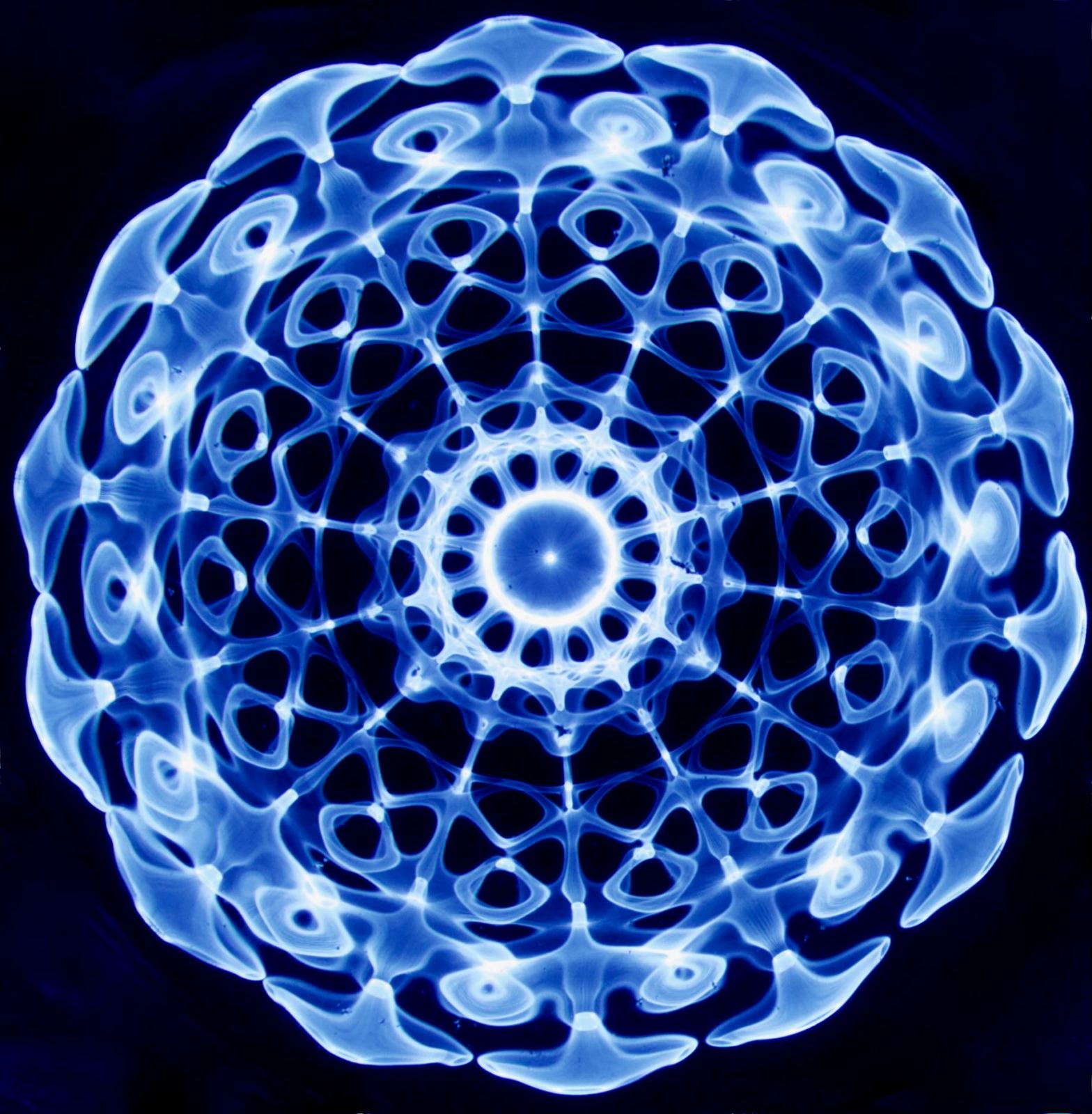
Featured image is cymatic pattern produced by sound vibrations in water by Stefaaane Shan, via Wikimedia Commons, licensed under CC BY-SA 4.0.
 Unity in Difference

2 comments
Comments are closed.