We search for peace as if it were the highest goal. We try to remove suffering and agitation, hoping to find a state of satisfied equilibrium. But suppose we did achieve that state, would it be enough?
The last article in this series described how aligning ourselves with the universal good produces existential well-being. The rational structure of reality naturally moves toward the universal good. When our will moves in harmony with that, there’s no friction. This creates a background resonance and produces a state of being that’s satisfied, peaceful, and unagitated.
This peaceful background is a precondition for flourishing. Alignment ploughs the field and removes the weeds, but it’s not yet planted with things that can grow. Peace is equilibrium, it’s the absence of agitation and suffering. But it’s also the absence of the positive state of joy.
Suffering disappears when we align with the universal will because a self-centred will revolves back into itself. Over time this crystallises into attachment. Attachment binds the will to particular outcomes, causing it to revolve within itself. Self-centred willing produces attachment, attachment produces inertia, and inertia produces suffering.
Our will forms a particular orientation toward the world, and when that orientation is repeated often enough, a habit is formed. When a habit becomes established, the will plays less of a role in our choices. The habit carries the action forward on its own momentum.
We often do things on autopilot, performing activities while our consciousness is absorbed in other thoughts. Most of us have experienced driving somewhere and been so absorbed in thought we arrive at our destination with no memory of the trip. Our body reverted to habitual movement while our consciousness was absorbed elsewhere.
Habit reduces the need for active will. Our behaviour becomes an inertial movement, a tendency to continue on the same path. We can dissolve these inertial grooves by changing the orientation of our will. Instead of directing our will toward our own parochial interest, we extend it beyond ourselves to align with the universal will.
Our will moves from a self-centred orientation to a universal orientation. When we align with the universal will, without attachment to the results, it produces peace. We’re no longer in control of the outcome, only our own actions. If we’re attached to a particular outcome for personal benefit, it produces agitation because our peace depends on that outcome.
Removing attachment to outcomes brings us to a state of peaceful equilibrium. But peace is the ground, not the final destination. The obstructions have been cleared, but consciousness doesn’t rest there.
Peace is not enough
Consciousness is dynamic, so even after achieving peace and equilibrium, it continues to orient itself toward something. And that orientation is always in a positive direction toward the good.
Fulfilment is the deepening movement of consciousness beyond equilibrium. Equilibrium is stability, but fulfilment intensifies and makes consciousness richer. Intensification implies dynamism, and this implies change.
We might think that change implies a lack, and so equilibrium is the ultimate state. But it’s only corrective movement that implies a lack. Movement can also arise from fulfilment, from the overflow of abundance. If our cup is full, any movement causes an overflow. So fulfilment isn’t movement that arises from a lack, but one that naturally arises from plenitude.
This is the kind of movement that takes us beyond equilibrium. It takes us beyond the correction of a negative state, and into an ever-deepening positive state of joy.
A musician who creates once they have mastered their craft isn’t moving from any lack, they’re expressing their perfection. Their abundance naturally flows in a certain direction. Their melody contains within it equilibrium, it has moments of silence, structure and rhythm. But it’s also inherently relational. Music must have relation between notes, otherwise it’s mere sound, not a harmonious melody.
Consciousness that has freed itself from self-referential attachment doesn’t become still, it seeks an object. Just as the melody requires relation, so does the will.
Our will seeks the infinite
Once consciousness is free from the revolving imprisonment of self-centred attachment, it can’t remain static. Turning inward toward itself means turning toward a self in peaceful equilibrium. Self-sufficiency is static, it’s reached its resting state and found completion. But rest and completion can’t deepen or intensify.
Fulfilment can’t be self-contained, overflow must move toward an object. If fulfilment implies a relational overflow, what does this imply about the object consciousness moves toward?
The answer becomes clearer if we consider the direction of our will. When we direct our attention toward the finite, the infinite is occluded from our view. But our real desire is for the infinite. Our will always seeks the whole.
We seek knowledge, but our search is for complete knowledge, the Theory of Everything that explains all other things. We seek joy not as a momentary experience, but a lasting and complete state of being. We are by our nature, ceaselessly drawn toward the ultimate good.
So in all ways we seek the infinite, but our desire is thwarted when the object of our will is focused on the finite. Our inherent orientation is toward the complete and the perfect, but when we seek it in finite and limited things, we return disappointed.
A finite object cannot satisfy an infinite orientation of will.
This infinite orientation of the will is a movement toward the highest good. This isn’t a movement toward a static endpoint, but a continuous good we participate in as a dynamic and living reality. Participation isn’t passive. The movement of the will can’t deepen unless it receives a response, and this implies relationship.
Love Requires a Person
Since participation requires relation, what kind of object could receive that overflow?
Attachment toward matter is self-referential, we engage with matter to please ourselves. Material objects can’t be pleased or reciprocate with us. We can direct our will toward finite objects or people, but no complete response is possible. Finite objects are changeable and impermanent.
Attachment is a form of love, but love directed toward inanimate objects can’t be reciprocated. The problem isn’t that we love or that we’re attached. It’s that we love things that can’t reciprocate in the way we need them to for lasting joy.
Think of trying to love someone who doesn’t or can’t reciprocate. It’s a form of love, but it’s tinged with grief. It’s not pure or complete. It’s a limited form of love that can’t find its fulfilment because the direction is one way. True love requires response and return. It requires reciprocation.
We can’t fully love humanity in the abstract, or love the highest good as a principle. We can admire it in a detached way, but we can’t find joy unless the object of our love can reciprocate. An impartial object can produce alignment, but not love.
For consciousness to deepen and intensify there must be overflow. Our will must be directed toward something that can respond, and it’s this responsive relation of mutual wills that can create intensification.
In the universal will we find response that removes agitation, but in the infinite we find response that reciprocates. The infinite can provide us with a personal and individual response.
The highest good can’t be grasped and held like an object, it can only be participated in. Love is the most complete form of that participation. The will gives itself freely to what it recognises as good, and the object of its love responds.
Love isn’t one good among others, it’s the mode in which consciousness fully participates in the good itself.
If the fullest and most dynamic expression of consciousness is a love that overflows, then the infinite and Absolute must be capable of receiving it. And if it’s capable of receiving and returning love, the Absolute must be a person.
Reciprocation requires an intentional response, and an intentional response presupposes a subject. Therefore, the ultimate object of love that can produce reciprocal joy must be a subject. If the ultimate ground of consciousness was impersonal, then personality would be derivative and love couldn’t be ultimate, it would be contingent.
What it means to say the Absolute is personal
When we say the Absolute is a person, we shouldn’t think of a finite ego, but an infinite subject. If the Absolute was one person among many, that would make it one item within reality. The Absolute isn’t a being like you or me. The Absolute is the ground on which all things stand, the necessary foundation of all that exists.
A person in the fullest sense is a centre of knowledge, will, and love. The Absolute has these features not as psychological traits, but as the ground from which all finite expressions of those features derive.
If the Absolute is personal and capable of reciprocating, then the movement of consciousness toward it isn’t absorption, it’s relationship. The goal of relationship isn’t to merge into the Absolute. The individual subject isn’t an obstacle or an illusion but a necessary participant.
This means relation isn’t something accidental, it’s inherent to the nature of the ultimate reality. If relation is intrinsic to consciousness and the Absolute is the fullness of consciousness, then a final state that dissolves relation doesn’t fulfil consciousness. It negates it.
So the ultimate state of consciousness can’t be one that dissolves relation or individuality. If relation is intrinsic to the Absolute, then the question is no longer whether we relate. We must stand in some kind of relation to him. Our only choice is what the nature of that relationship will be.
Why the Absolute is hidden
The Absolute is the source of everything in existence. Everything exists relative to the Absolute, which means all things stand in some kind of relationship to it.
Relationship to the Absolute isn’t one feature of existence among others. It’s the condition of existence itself.
If we can’t avoid some kind of relationship, that means we must already be in a relationship, whether we’re aware of it or not. Our only choice is what form the relationship takes and how we will relate. The Absolute is personal, but since we have free will, we choose how to relate to him.
The nature of that choice matters, because the relationship we’re capable of isn’t merely functional, it’s personal. And that means we’re capable of love. For love to be reciprocated it must be between persons. But love also requires freedom. It can only be given freely, because if it’s coerced, it loses its inherent nature as love.
If there is freedom, there must be the possibility of refusal or withholding a response. This isn’t a psychological observation about the nature of human love. It means the nature of the Absolute must include room for a refusal to reciprocate. This freedom isn’t a limitation of the Absolute, it’s an expression of his nature as love. This has consequences for how we understand our situation.
The Absolute is responsive because personal relationships are responsive by nature. So the Absolute responds to us according to how each individual chooses to approach him. He reciprocates with us on our chosen terms. When there is refusal and withholding of a response, the relationship with the Absolute doesn’t disappear. It becomes distant.
If we ignore or deny him, he respects our choice and remains hidden. The silence of the cosmos isn’t the absence of the Absolute, it’s a restraint of his presence. Divine hiddenness isn’t evidence of the non-existence of the Absolute. It’s evidence of non-coercive love.
The vast reaches of space, the unimaginable distances of the universe are the concrete form of our distant relationship to the Absolute. This is the hiddenness of the Absolute. It’s as distant a relationship as it’s possible to have. We don’t even know with certainty if he exists, and reliable information about him seems elusive.
The vastness of space expresses the experiential distance of our relationship. The cosmic silence is our chosen relational stance. These are the conditions of our existence in this world and these conditions are our chosen orientation toward the Absolute.
This orientation doesn’t require reflective awareness. Even beings who can’t consciously reflect on the Absolute still participate in a relational orientation, because the structure of consciousness expresses a direction of will. Our existential situation is the expression of a long history of orientation, most of which operates beneath conscious awareness.
This orientation isn’t merely an abstract metaphysical stance, it affects the felt quality of our experience. Our experience depends on the object it’s directed toward and its capacity for response. Occlusion is the limiting form of relationship, it’s something like when we say “he’s dead to me”. Not that he is dead, but our relational orientation excludes him.
If this is the most distant relationship possible, and we already exist in that state, what would it mean to move closer to the Absolute?
Intimacy as ontological depth
This isn’t a relativism in which any relationship with the Absolute is equal and merely a matter of opinion. Like any personal relationship, the relevant scale is one of intimacy. These stages of relationship don’t represent psychological states, they describe the structure of reality. If reality is intrinsically relational and relation is personal, these stages represent ontological depth. A scale of intimacy represents moving closer to the heart of reality, to its quintessential features.
These relationships are different modes of existence that must be understood in terms of relation. They describe the depth of the reciprocation and increasingly complete knowledge of the Absolute as a person. Just as physics moves from surface mechanics to deeper field structures that are more fundamental, intimacy here means moving closer to what is most fundamental in reality, not merely warmer in feeling. If consciousness is the substance of reality, this isn’t a description of psychology, but of the structure of reality itself.
We can think of the various relationships to the Absolute with a familiar example. A monarch is one person who has many different relationships. His citizens relate to him in an impartial way, they don’t know him by name or have access to his private life. Their interactions are indirect and only concerned with the functioning of the public environment.
Moving closer to the king we have his public servants. They interact with the king as a person but in a formal relationship. They may address him by his title, Your Majesty, rather than his name. But they have some knowledge of his personal preferences, how he likes to organise his day, and they accommodate that in their service.
Closer still are his friends. Now there is equality between persons. His friends call him by his first name, they may give him an affectionate nickname and tease him. They know his personal likes and dislikes.
Once we reach personal relationships, the king’s position of power has receded into the background. His power remains intact, but it’s inactive and ignored because its presence would impede the friendship. In personal relationships there must be an equality between persons.
As we move even closer in a personal relationship, we come to the king’s family. These people are at the most intimate level of relationship. Parents serve their child, they pander to him and try to please him. But they may also discipline and advise him. Now the power of the king has not only been eclipsed, it’s been reversed. The parents protect him as if he was helpless.
An even closer relationship is a spouse who knows him in a more intimate way. The king willingly reveals his mind and heart to her. Beyond this is the most intimate level, one in which everything, even social respectability is sacrificed for the relationship. This represents the pinnacle of intimacy because it embodies complete self-surrender.
These modes of intimacy aren’t descriptions of emotions. They’re degrees of self-disclosure and surrender of will.
When Love Overflows
The highest form of love is complete self-surrender. This isn’t the extinguishing of the individual self in order to merge and lose individuality. This is oneness within relationship. The beloved is ours, as dear, or more dear to us, than our own self. And we belong to our beloved in the same way.
There is no greater unity that retains difference and respects the sovereignty of each individual. This is the fully dynamic non-dual state.
Love is the supreme and most intimate form of relationship. We’re willing to give our whole self and sacrifice our own pleasure for the well-being of our beloved. Love is the surrender of self-concern, and a total commitment to the welfare of the beloved.
And this is a dynamic state. As we please the beloved, this sparks an impetus in them to please us, and this movement continues in a self-perpetuating and leapfrogging embrace. We become one. The movement of consciousness and will becomes completely entwined and moves in an increasingly fulfilling direction.
The inherent nature of love is self-surrender of our will to the beloved’s will. Our wills are intertwined. Since will is the inherent movement of consciousness and is dynamic in nature, love is the ultimate form of oneness. Not a static oneness, but a mutual relational oneness that is infinitely deep, endlessly dynamic, and by its nature overflows to inundate everything in its path.
The dynamic nature of light consists of electrical energy which produces magnetic energy, which in turn gives rise to electrical energy, in a self-perpetuating chain. When light moves, neither the electric or magnetic power is primary. Their response and interaction is the generative principle. In the same way, it’s not the power of the individuals in a relationship that are the source of the dynamism.
Love itself is the generative principle. It’s love that is self-sustaining and reveals the deepest heart of the personal reality.
This is what it means to participate in the highest good. This isn’t something we observe from a distance, or merely align with. Relationship is participation, it’s reciprocal participation by nature. Love is the highest mode of that participation because in love each will freely offers itself to the other and the good is shared and amplified in a dynamic and reciprocal exchange.
Love is the supreme controlling principle of all reality. Even the all-powerful Absolute bows down to love and surrenders control to its natural flow.
Power isn’t the ruling principle. Love is.
Love then, is the deepest expression of the nature of the Absolute. It is the quintessence of consciousness and only finds its complete expression in the infinite and absolute consciousness. For it’s only in the infinite that we can find complete knowledge, complete existence, and complete and everlasting joy.
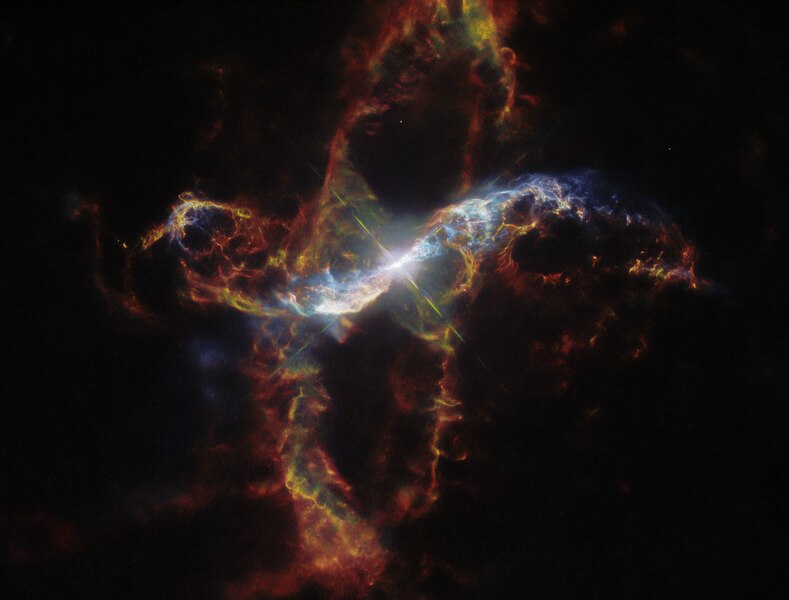
Lead image: R Aquarii, a symbiotic binary star system. Credit: NASA/ESA (ESA/Hubble), Stute et al. CC BY 4.0.
 Unity in Difference
1 comment
Comments are closed.